Log Entry 1: My Personal Baseline
Understanding myself through self-awareness frameworks and communication analysis.
🪞 1. Self-Awareness – Johari Window (Blind Spots & Hidden Area)
Gathering Feedback Through the Johari Window
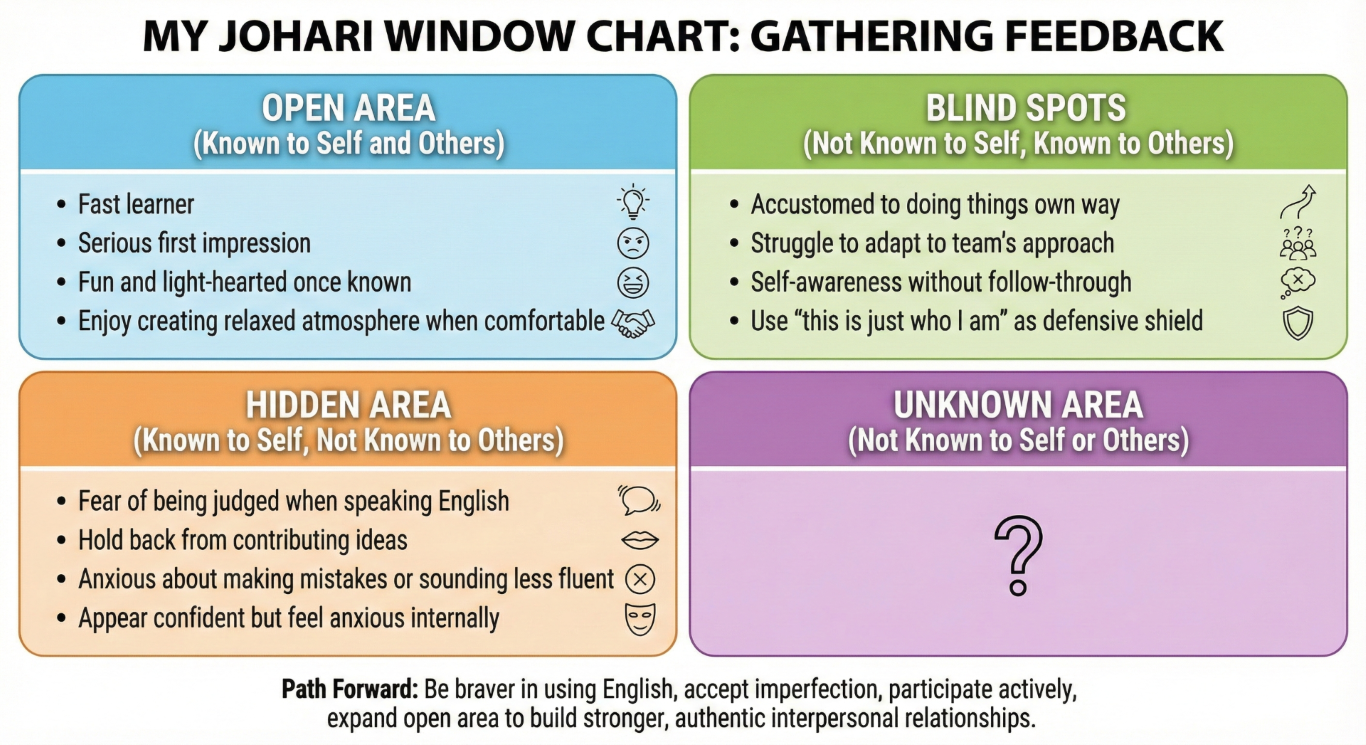
I used feedback from two close friends, Wong Coey and Angelina, to reflect on myself using the Johari Window framework. Their honest observations helped me identify what belongs in my open area, blind spots, and hidden area. Through this process, I came to realise that some of my traits are visible to everyone around me, while other habits remain harder for me to acknowledge—even though they still significantly affect how I collaborate and interact with others.
Open Area and Blind Spots
For my open area, both Wong Coey and Angelina perceive me as a fast learner who gives off a serious first impression, yet is actually fun and light-hearted once people get to know me. I agree with this observation because I tend to appear reserved initially, but I genuinely enjoy creating a relaxed and friendly atmosphere when I feel comfortable with those around me. However, their feedback also revealed several blind spots that I had not fully recognised. Wong Coey shared that I am accustomed to doing things my own way and often struggle to adapt when the team prefers a different approach. Similarly, Angelina pointed out that I frequently demonstrate self-awareness without follow-through, and that I sometimes use the notion of "this is just who I am" as a defensive shield. I strongly resonate with these insights because I know I tend to procrastinate, overthink, and become defensive—yet I continue repeating these patterns instead of actively changing my behaviour.
Hidden Area and Path Forward
My hidden area contains aspects of myself that I usually do not reveal to others. One significant example is my fear of being judged when speaking English, which causes me to hold back from contributing even when I have valuable ideas to share. On the surface, I may appear confident or composed, but internally I often feel anxious about making mistakes or sounding less fluent than my peers. This realisation has shown me that if I truly want to grow, I need to be braver in using English, learn to accept imperfection as part of the learning process, and participate more actively in discussions rather than retreating into silence. By gradually expanding my open area and addressing both my blind spots and hidden fears, I believe I can build stronger, more authentic interpersonal relationships.
🧠 2. Synthesis – Thinking vs Communicating
My Problem-Solving Style: Intuition Over Logic
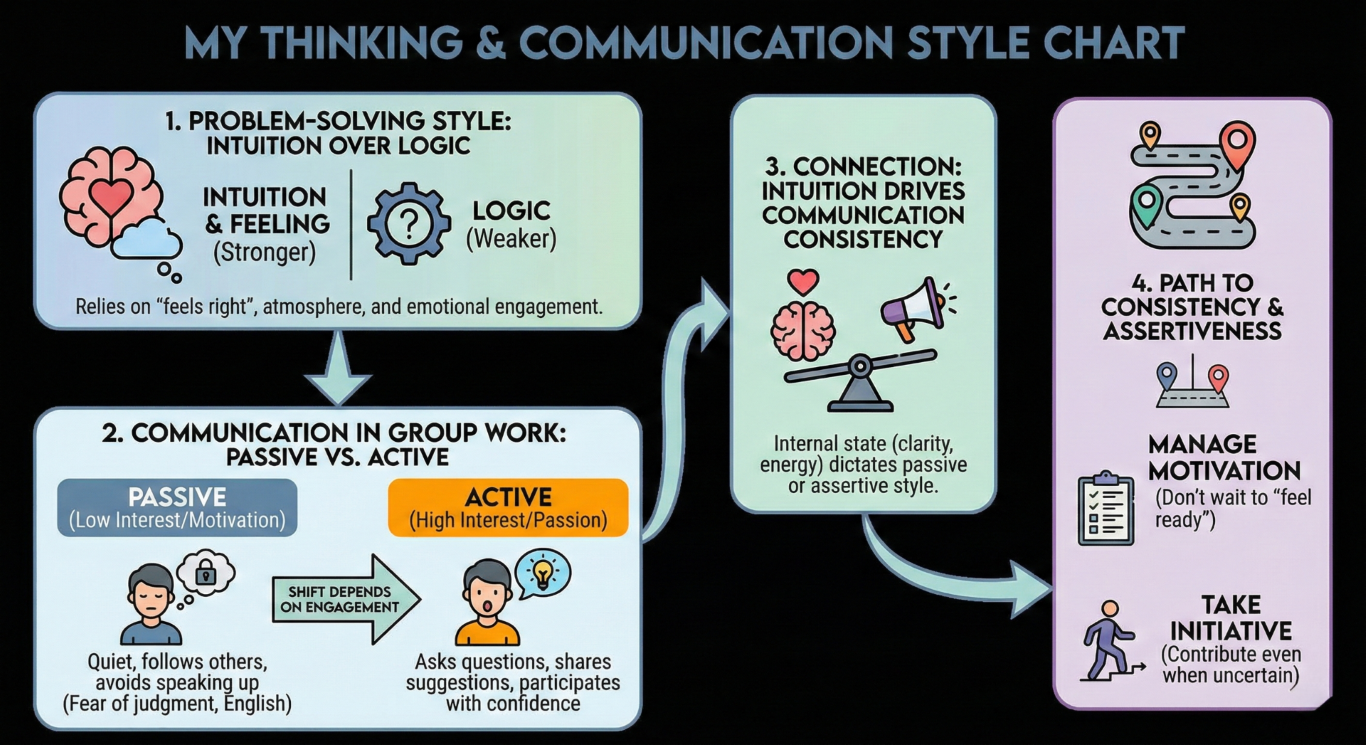
In my Coursework 1 Role Model Inquiry, I realised that my problem-solving style is a blend of logic and intuition—however, my intuitive and feeling-based side is actually the stronger of the two. I tend to rely on how I feel about a situation, the overall atmosphere, and whether something "feels right" to me, rather than strictly following a step-by-step analytical structure. When I am genuinely interested and emotionally engaged, I can understand concepts quickly as a fast learner and generate ideas quite naturally.
How My Thinking Style Shapes My Communication
This thinking style strongly influences how I communicate during group work. When I do not yet have ideas, feel unmotivated, or am not emotionally engaged, I usually become more passive in my communication. I tend to keep quiet, follow others, and avoid speaking up—especially when I am unsure or worried about being judged, such as when speaking in English. However, once I begin thinking deeply and develop a sense of passion or ownership towards the group work, my communication becomes much more active. I start asking questions, sharing suggestions, and participating with greater confidence.
The Connection Between Intuition and Communication Consistency
Because my intuition and emotions drive both my thinking and my communication, my style can shift from passive to more assertive depending on my internal state. When I feel unclear, tired, or disconnected, my intuitive side causes me to hold back. But when my interest and motivation are high, that same intuitive strength helps me support the team with energy and creative ideas. This connection has made me aware that to communicate more consistently and assertively, I need to actively manage my motivation and not wait until I "feel ready" before contributing. Taking initiative—even when I am uncertain—is a crucial step toward becoming a more reliable and effective team member.
💬 3. Communication Style
The Situation: A Class Group Discussion
One situation that clearly demonstrates my communication style occurred during a class group discussion about a company turnover plan. Our group was tasked with deciding which company to choose and how to draft the proposal. Because I was more familiar with that particular field, I began to speak up very actively. I quickly suggested my own idea for the company and the direction of the plan, then proceeded to explain my views in detail to my teammates.
Identifying My Communication Style
In that moment, my style leaned towards the aggressive side of the communication spectrum. I dominated the discussion by pushing my ideas first and leading the direction, rather than waiting to hear everyone else's opinions. The positive outcome was that my teammates gained ideas quickly, our group established a clear direction, and they started to trust my knowledge and guidance. However, this approach also meant that I unintentionally took control of the conversation without creating sufficient space for others to contribute their perspectives.
Reflection and What I Would Do Differently
Looking back now, I can see that I did not give enough space or time for my teammates to express their own thoughts. While my intentions were good—wanting to help the group progress efficiently—my approach may have made others feel that their opinions were less valued. If I could redo the situation, I would still contribute my ideas but pause more intentionally to invite others to share their views. By asking questions like "What do you think?" or "Does anyone have a different perspective?", I could ensure that the discussion becomes more balanced and collaborative, rather than being driven mainly by my voice. This experience has taught me the importance of blending confidence with active listening.
✨ 4. Social Etiquette – Grooming & Digital Etiquette
Personal Grooming on Regular College Days
In terms of personal grooming, I usually dress in a simple but neat manner on normal college days. I often wear a T-shirt paired with long pants, and I make sure my clothes, hair, and overall appearance look clean and presentable. Even when the dress code is casual, I still pay attention to basic grooming because I understand that it affects how lecturers and classmates perceive my seriousness and respect for the learning environment. First impressions matter, and I believe that taking care of my appearance reflects my attitude toward my studies.
Elevating My Appearance for Formal Occasions
For presentations or more formal academic moments, I intentionally raise my standard of appearance. I wear a collared shirt with long pants, and I make sure my shirt is properly ironed. This creates a more serious and professional image, which aligns with the responsibility of presenting work on behalf of my group. Dressing this way also helps me feel more confident—it is as if I am "stepping into" a more professional version of myself. The act of preparing my attire becomes part of my mental preparation for important tasks.
Digital Etiquette and Communication Habits
My social etiquette also extends to my digital behaviour. In group chats, I tend to reply quite quickly and sometimes use emojis to make conversations more relaxed and light-hearted, which helps reduce tension and keeps the atmosphere friendly. At the same time, when I communicate with lecturers or advisors, I consciously switch to a more formal tone, using proper greetings, complete sentences, and polite closings to show respect. One good habit I am proud of is my quick responsiveness; however, I recognise that I still need to improve the clarity of my messages. Sometimes I reply fast but not deeply enough, so moving forward I want to focus on being both responsive and clear to support smoother and more effective teamwork.